Along Somalia’s coastline, communication is the first decisive response to an incident at sea. Every call, transmission, or signal received in the communications room sets the response in motion. From these rooms, officers assess distress alerts, verify coordinates, monitor vessel movements, and coordinate responses across maritime agencies. When time, distance, and visibility are critical, communication shapes operational decisions.
Marine Communications training was delivered throughout the year through three structured training sessions. A core group of officers progressed through all phases, strengthening their skills through practice and experience. The trainings were supported by the United Nations Office on Drugs and Crime Global Maritime Crime Programme, with funding from the Government of Japan under the project Establishing Regional Training Capacity for Maritime Security for the Horn of Africa.
Participants came from institutions central to maritime response. Officers from the Somali Police Force Department of Coast Guard trained alongside officers from the Ministry of Ports and Marine Transport and the Ministry of Fisheries and Blue Economy, all performing communications roles critical to maritime coordination. Training together reinforced the need for consistent procedures and clear information flow when incidents unfold.

The initial training focused on technical foundations, introducing officers to marine radio functions, signal propagation, and common causes of communication failure. Practical sessions allowed participants to handle equipment directly, test transmissions, and resolve faults drawn from daily operational experience.
The second training built on these foundations and was delivered through the Maritime Rescue Coordination Centre Operator Equipment Training programme, with a strong focus on Maritime Operations Centre functions. Conducted over two weeks, this phase shifted learning from system familiarisation to coordinated operational use of monitoring and communications systems. Participants worked with coastal monitoring systems, electronic chart display and information systems, radar overlay, Automatic Radar Plotting Aid, and Automatic Identification System integration to strengthen situational awareness and support real-time maritime response. During this phase, the National Instructor supported the training by ensuring that technical instruction was applied through national operational practice. He guided participants on how information is processed, escalated, and acted upon within Somalia’s maritime response structures, reinforcing consistency between system use and operational decision-making.
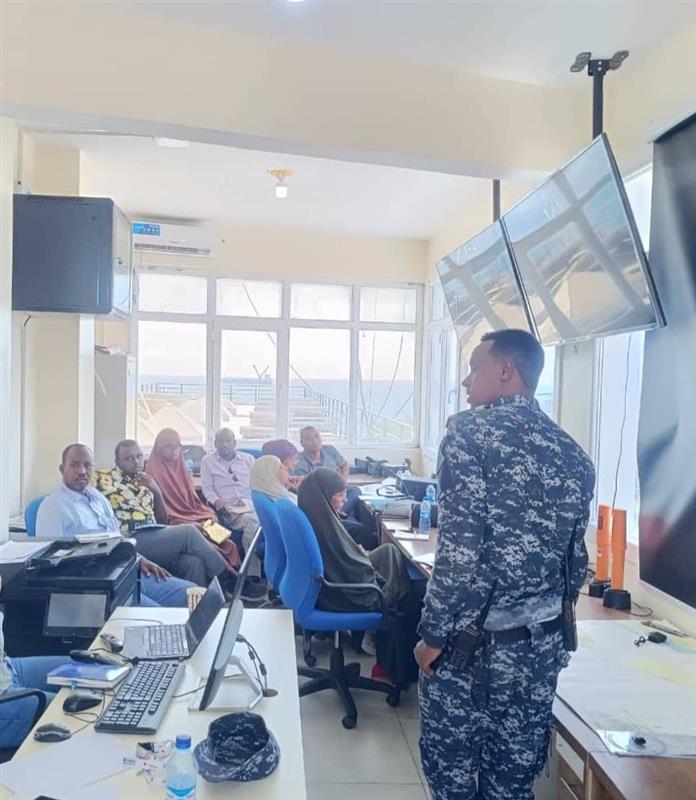
For officers from partner institutions, this training's impact was directly felt in daily operations. An officer from the Ministry of Fisheries and Blue Economy's Monitoring Control Centre reflected that the training strengthened practical skills in maritime communications and radar operations. It enabled more effective vessel tracking, real-time information sharing, and support to coordinated maritime security during both routine and emergency operations. The officer noted these capabilities will directly enhance safety at sea and strengthen inter-agency cooperation in day-to-day work.
Another participant highlighted the operational value of standardised radio procedures. The training strengthened understanding of disciplined radio communication during boarding operations. By gaining hands-on skills in managing multiple radio systems, including Very High Frequency, High Frequency, and Medium Frequency radios, and responding to suspicious vessels more effectively, the officer noted that operational safety and effectiveness at the Fisheries Monitoring Centre will be significantly enhanced.
The final training marked a decisive shift to national delivery, led entirely by the National Instructor from the Somali Police Force Department of Coast Guard. Drawing on extensive operational experience, he led the delivery of advanced communications training that reflected the realities faced by Somali maritime responders. Building on skills developed earlier in the year, he guided participants through higher-pressure scenarios, moving them beyond individual tasks to managing the full communications cycle as it unfolds during real maritime incidents.
Under his leadership, participants applied disciplined maritime voice procedures, structured call handling, and GMDSS protocols, working through complex scenarios that required them to verify distress calls, prioritise incoming information, and issue clear instructions that shape responses beyond the communications room. The training reinforced not only technical accuracy, but also confidence and decisiveness, qualities essential for officers responsible for directing maritime response.
Reflecting on this responsibility, the National Instructor emphasised the critical role communications officers play long before any assets arrive on scene.
"In marine communications, our work begins long before a vessel arrives on scene. Every decision we make, every instruction we give, shapes what happens next. This training is about ensuring officers can think clearly, communicate accurately, and act decisively when it matters most," said Lieutenant Ayub.