 Facebook
 Twitter
 Flickr
 YouTube
South Asia: UNODC-facilitated exchange visits strengthen customs capacities and cooperation against organized crime

Istanbul and Ankara, Türkiye and Colombo, Sri Lanka/11 December 2025: Exchange visits are a powerful tool to strengthen capacities of law enforcement officials and enhance border security. By allowing Customs officials to observe operations first-hand, exchange practices, and openly discuss shared challenges, such visits enable peer-to-peer learning, promote cross-fertilization of ideas and build trust and cooperation between authorities across borders.
In December, two separate exchange visits were carried out under the UNODC Passenger and Cargo Control Programme (PCCP) to strengthen operational capacity and cross-border cooperation. Maldives Customs undertook an exchange visit to Türkiye, while Nepal Customs engaged in a dedicated exchange with Sri Lanka Customs, each tailored to distinct operational contexts and learning objectives.
12 officials of the Maldives Customs visited the Türkiye Directorate General of Customs Enforcement (DGCE), gaining in-depth exposure to advanced border control operations in a major global transit country. Türkiye’s geographic position at the crossroads of Asia, the Middle East and Europe makes it a key transit point for illicit drugs, particularly concealed in containerized trade. During the visit, Maldivian officers observed passenger control operations at Istanbul Airport, one of the world’s busiest aviation hubs handling nearly 50 million travellers annually. End-to-end screening processes, including X-ray baggage inspection, detection dogs, and advanced passenger profiling using Advance Passenger Information (API) and Passenger Name Record (PNR) data, illustrated how high-risk passengers can be identified while facilitating legitimate travel.
The visit to the DGCE National Command and Control Center in Ankara further strengthened understanding of intelligence-led Customs control. Through a national single window system, Turkish Customs demonstrated real-time monitoring of cargo and transit trucks using centralized data, GPS tracking and CCTV. Maldives Customs officers exchanged first-hand insights into container profiling, risk scoring and the effective use of non-intrusive inspection technologies to target high-risk shipments without disrupting trade. The exchange also enabled both administrations to compare national approaches to cargo and express mail controls, including challenges linked to the rapid growth of e-commerce.
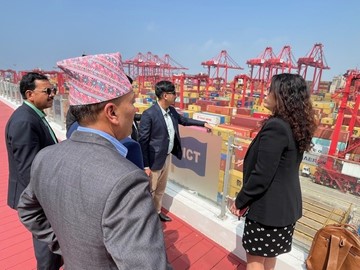
Similarly, an exchange visit between Nepal Customs and Sri Lanka Customs significantly strengthened institutional knowledge and regional cooperation. 8 Nepalese officials were exposed to Sri Lanka’s advanced border management practices, risk-based cargo controls and integrated approaches to trade facilitation. A visit to the Colombo Mega Port initiative highlighted modern port infrastructure, large-scale transshipment operations and the role of Customs in supporting national trade competitiveness.
A key outcome of the Nepal–Sri Lanka exchange was the strong emphasis on public–private partnerships. Engagements with port authorities, terminal operators, airlines and logistics providers demonstrated how collaboration with the private sector improves compliance, streamlines clearance and strengthens border security. Operational demonstrations at port examination areas, mail centres and the PCCP Air Cargo Control Unit showcased effective targeting, profiling and real-time decision-making in cargo and express consignment environments.
Across both exchange visits, officers openly shared national strategies, risk management methodologies and operational priorities. These interactions reinforced professional networks, supported the adoption of best practices and highlighted the importance of coordinated, intelligence-driven responses to transnational organized crime. Funded by the U.S. Department of State’s EXBS Program, PCCP exchange visits continue to translate cooperation into stronger, more resilient Customs controls across South Asia and beyond.
This activity contributed to SDG 16 and SDG 17: https://sdg-tracker.org/
(Supported by the US Government)