Two benzodiazepine-type NPS,
desalkylgidazepam (also known as bromonordiazepam) and
ethylbromazolam, are under critical review by the World Health Organization (WHO) Expert Committee on Drug Dependence (ECDD) and were discussed at its
49th meeting, held on the
19-22 October 2026. The
UNODC Laboratory and Scientific Services attended as observers and provided the latest data and insights from the
UNODC Early Warning Advisory on New Psychoactive Substances (EWA) on substance identifications in drug samples and toxicology cases. The UNODC Global Network of Forensic Laboratories are vital to provide evidence for the prioritization and risk assessment of such emerging benzodiazepines. UNODC extends its gratitude to all the recent data contributors participating in our
International Collaborative Exercises (ICE) programme,
toxicology data collection exercise, monthly EWA data submissions and the
Annual Report Questionnaire (ARQ).
Global trends and emerging threats New benzodiazepines continue to emerge across the global NPS market and remain an important component of the evolving drug landscape. Their international presence, structural diversity and increasing appearance in forensic and toxicological casework underscore the need for continued monitoring by laboratories and early warning systems. As of today, a total of 60 unique benzodiazepines have been reported to the
UNODC EWA by 74 countries across all continents. During the 2025/6 period, 51 unique benzodiazepines were reported, including 17 for the first time by multiple countries across 4 continents (Asia, Oceania, Europe, and North America).
Based on geographical reporting, the most widely reported benzodiazepines in 2025/6 were
etizolam (25 countries),
bromazolam (20 countries),
flualprazolam (19 countries),
desalkylgidazepam (12 countries), and
clobromazolam (10 countries), indicating broad international spread across multiple regions. During the same period, based on identifications in drug samples, a slightly different pattern is observed.
Bromazolam,
desalkylgidazepam,
clobromazolam,
ethylbromazolam,
ethylflualprazolam and
etizolam were among the most frequently detected benzodiazepines (listed in rank order). While data remain preliminary for 2025/6 and count data is variably reported globally with regional variation, this highlights the continuing expansion and diversification of benzodiazepines.
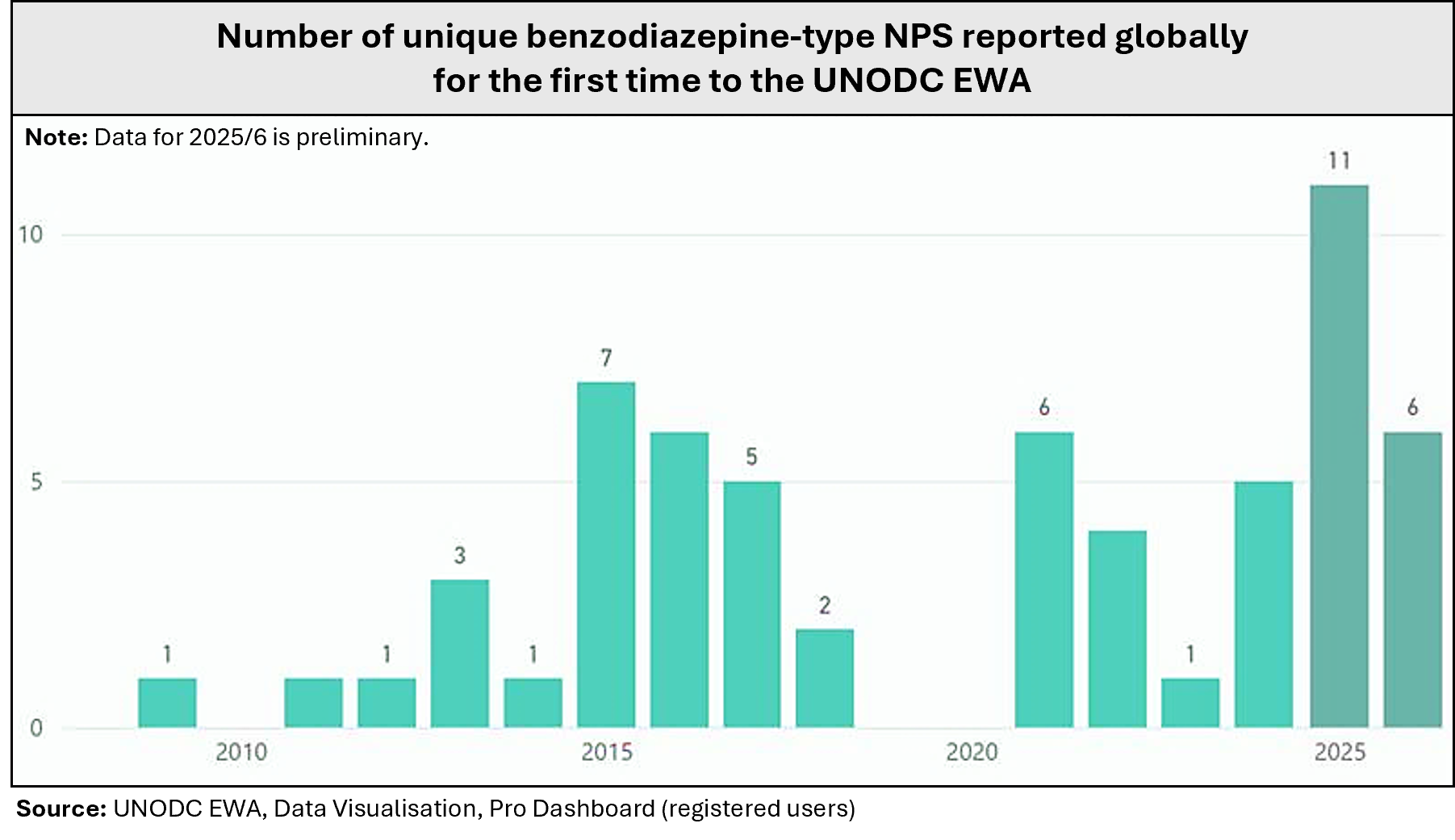
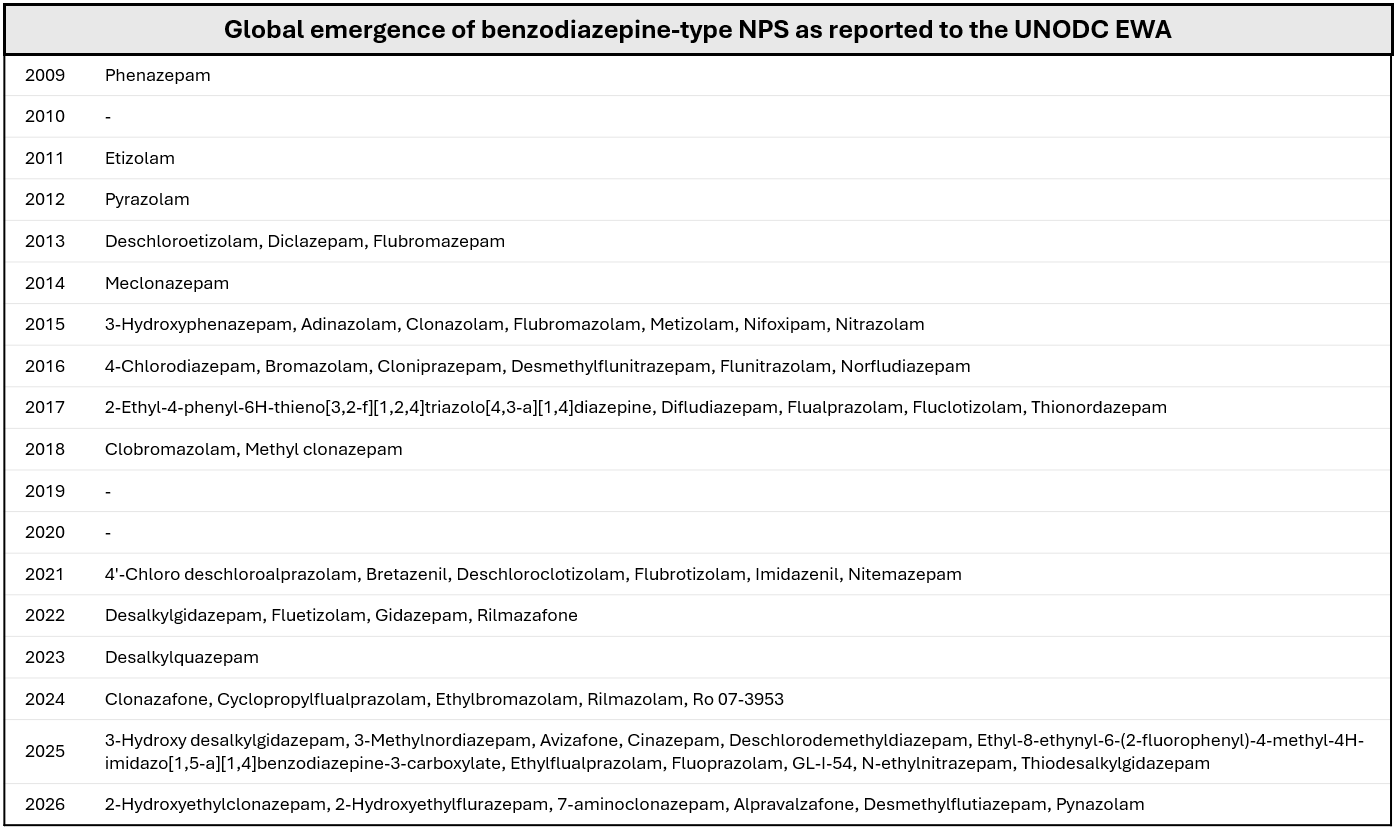 Emerging benzodiazepines not under international control
Emerging benzodiazepine-type NPS illustrate differing patterns of emergence, international spread, forensic detections and toxicological involvement.
Desalkylgidazepam shows the broadest geographical dissemination and the highest number of drug sample reports and toxicological cases, while
ethylbromazolam and
ethylflualprazolam demonstrate how newly emerging benzodiazepines can rapidly establish an international presence or re-emerge, such as
clobromazolam in some markets.
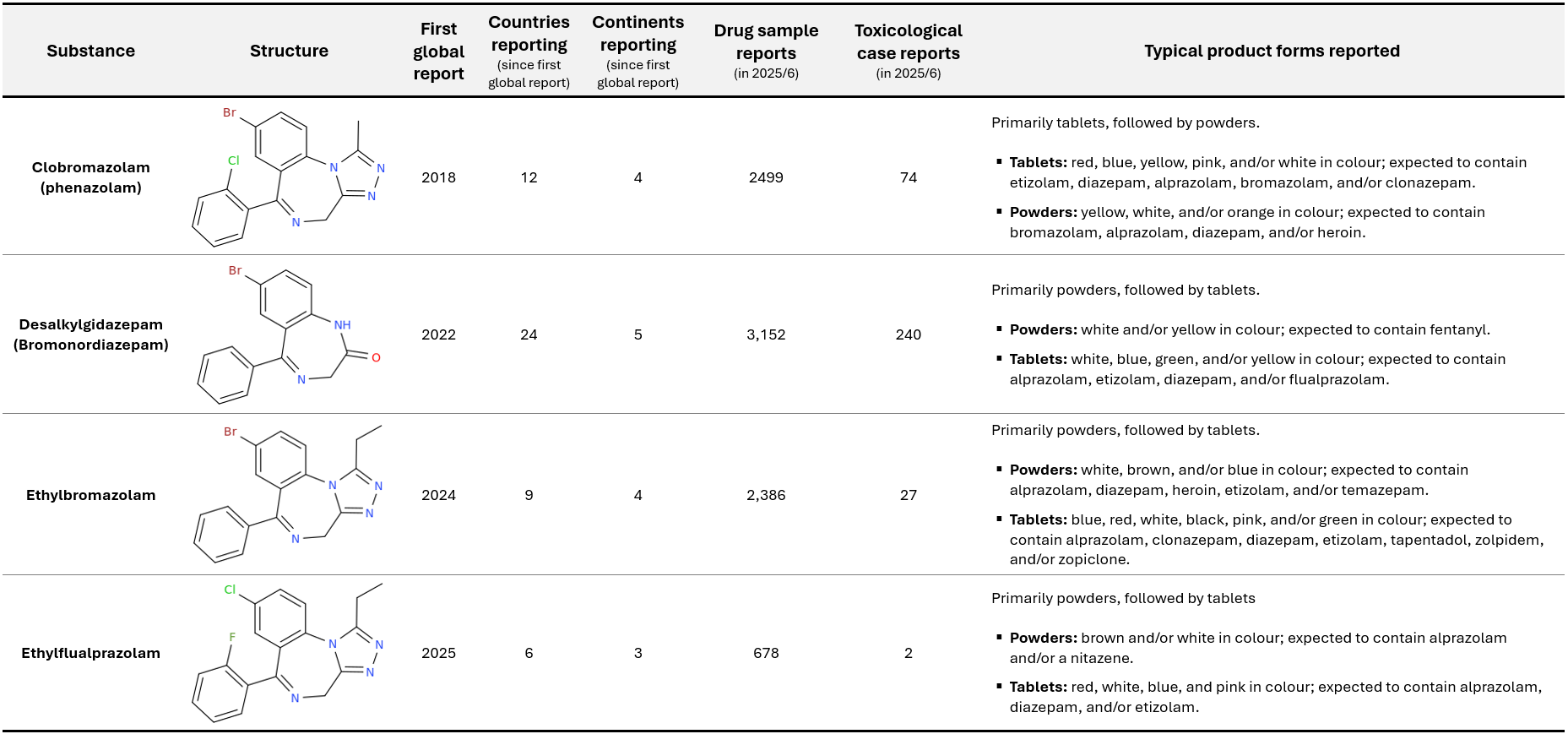 Forensic early warning as evidence
UNODC recently highlighted the value of the early warning advisory in globally monitoring the emergence, spread and persistence of substances such as benzodiazepine-type NPS in the
Journal of Analytical Toxicology. Beyond supporting the early identification of newly emerging substances, the
UNODC EWA data can also reveal how illicit markets respond to regulatory interventions. For instance, following the international scheduling of
bromazolam in 2024, the
UNODC EWA indicated declining
bromazolam detections alongside increasing reports of alternative benzodiazepines.
The value of forensic early warning extends further as the
UNODC EWA data help distinguish transient substances from those that become established across regions and over time.
Etizolam provides a key example. Although placed under international control in 2020, it has since been reported by 57 countries worldwide and continues to be detected regularly in forensic and toxicological investigations. Given its continued relevance,
etizolam is currently included in the
UNODC ICE Programme proficiency testing scheme to support laboratories in its detection and identification. Such findings demonstrate how early warning systems can help laboratories and policymakers determine which substances continue to require analytical and public health attention after scheduling.
The importance of international information sharing was reaffirmed by the 69th
Commission on Narcotic Drugs Resolution
69/3, adopted in March 2026, which calls for strengthened early warning mechanisms and multidisciplinary data sharing for new synthetic drugs, NPS, and precursors.
Implications for drug analysis laboratories The analysis of benzodiazepine-type NPS remains challenging due to extensive metabolism, inconsistent immunoassay cross-reactivity, structural similarity among analogues, and the continual emergence of new compounds. Limited availability of certified reference standards and gaps in pharmacokinetic knowledge can further hinder detection and interpretation. Consequently, as mentioned by
Ellefsen et al. (2026), drug analysis laboratories are encouraged to employ mass spectrometry-based approaches, including LC-MS/MS and LC-HRMS for toxicology laboratories, and to include major metabolites within analytical workflows to support reliable detection and identification.
Interpretation is further complicated by prodrug conversion and complex metabolic pathways. Recent reports have highlighted the emergence of several benzodiazepine prodrugs and precursor-related substances, including
noravizafone desglycyl,
diclazafone desglycyl, and
clonazafone desglycyl. These compounds are converted in vivo to active benzodiazepines and may be absent or present in biological specimens, making source attribution difficult. A recent study by
Norman et al. (2026) has also shown that some prodrugs, including gidazepam, exhibit pharmacological activity themselves, while their metabolites may display greater potency.
The relationship between parent compounds, metabolites, and precursors can be highly complex. For example,
gidazepam is metabolised to desalkylgidazepam, which itself is encountered as a NPS and can be further metabolised to active compounds such as
3-hydroxy desalkylgidazepam. Adding to this,
desalkylgidazepam is also a precursor in the synthesis of
bromazolam, and the two substances are frequently co-detected in both drug samples and toxicology cases. Such interconnected pathways increase the complexity of detection, identification, and interpretation of benzodiazepines in both drug chemistry and toxicology laboratories. Regular updates to analytical screening methods and mass spectral libraries are therefore essential to ensure emerging substances, metabolites, and precursor compounds are reliably captured.
Given that the average lifespan of an NPS in a national drug market is less than two years, near real-time reporting from drug analysis laboratories and national focal points worldwide is critical in providing insight into the emergence, spread, persistence and harms associated with these substances. By facilitating timely pharmacological, analytical, and toxicological information exchange, the
UNODC EWA supports evidence-based public health, forensic and policy responses and contributes directly to international substance review and scheduling processes.
For the latest information on benzodiazepines and other emerging substances, registered eligible users can access pharmacological, analytical, toxicological, and interactive detailed trend data through the UNODC EWA Pro dashboard. For more information: UNODC, “
September 2026 - WHO: Five new psychoactive substances and two medicines under review by 49th Expert Committee on Drug Dependence”, 3 September 2026
WHO ECDD Draft Critical Review Report:
Ethylbromazolam WHO ECDD Draft Review Report:
Desalkylgidazepam