BEIJING, China – 30 September 2026
On 23 September 2026, China’s Ministry of Public Security, National Health Commission and National Medical Products Administration jointly announced1 to place orphine analogues under national control using a broad generic definition as follows (unofficial translation):2
“Orphine analogues” refer to substances whose chemical structure, when compared to brorphine (1-{1-[1-(4-bromophenyl)ethyl]piperidin-4-yl}-1,3-dihydro-2H-benzimidazol-2-one), meets one or more of the conditions (1), (2), and (3); or, when compared to spirobrorphine (8-[1-(4-bromophenyl)ethyl]-1-phenyl-1,3,8-triazaspiro[4.5]decan-4-one), meets one or more of the conditions (4), (5), and (6):
- Replacing any number of hydrogen atoms in the 1,3-dihydro-2H-benzimidazol-2-one group with groups containing no more than five carbon atoms;
- Replacing the 1-(4-bromophenyl)ethyl group with any group other than hydrogen;
- Replacing any number of hydrogen atoms in the piperidine ring with groups containing no more than five carbon atoms;
- Replacing the phenyl group connected to the nitrogen atom with a substituted or unsubstituted aromatic group;
- Replacing the 1-(4-bromophenyl)ethyl group with any group other than hydrogen;
- Replacing any number of hydrogen atoms in the 1,3,8-triazaspiro[4.5]decan-4-one group with groups containing no more than five carbon atoms.
The control measures come into effect on 1 October 2026.
Global increases in orphines and their precursors
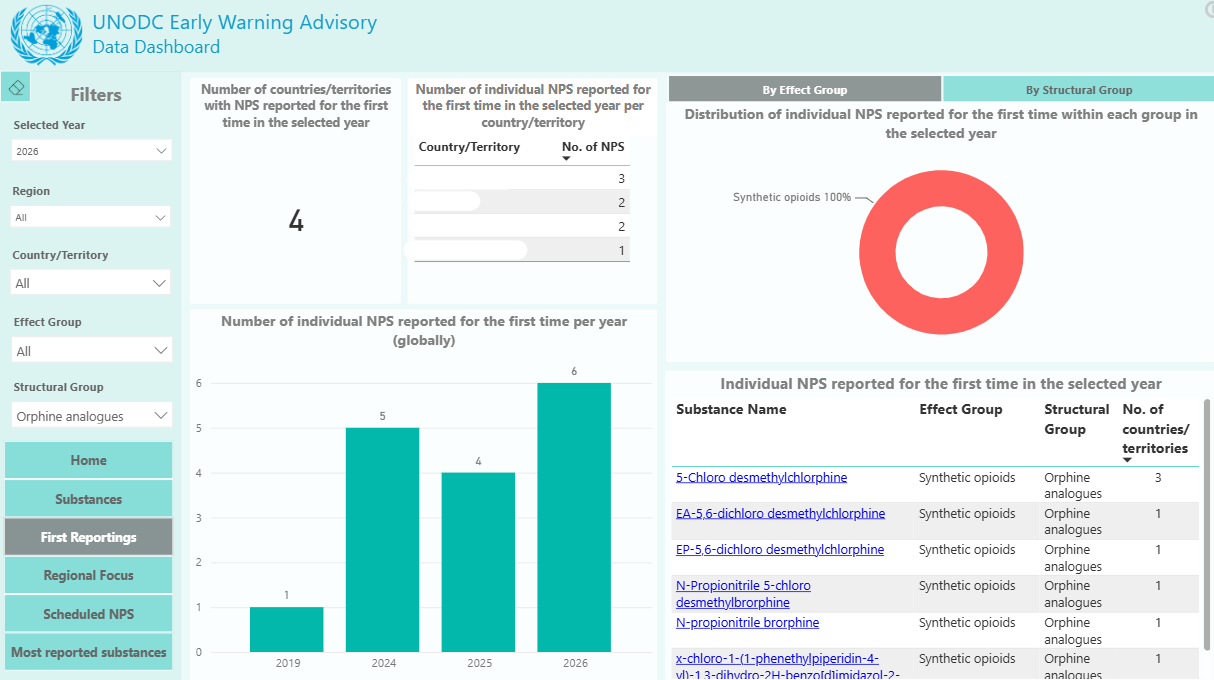
By February 2026, 10 orphine analogues had been reported to the UNODC Early Warning Advisory on New Psychoactive Substances(EWA). Since then, 6 new analogues have been reported:
In addition, a range of potential precursors have been reported to UNODC EWA, with some national control measures in response. For the latest data and access to the full lists of substances, laboratory analytical and pharmacological data, login is required (for registered eligible users).
International legislative responses
A number of countries have already implemented controls targeting orphine analogues. Control measures such as the individual listing of orphine analogues (some of which are temporary) are in place in countries such as Argentina, Canada, Denmark, Finland, Italy, Sweden, United Kingdom and the United States.3 Switzerland has introduced generic legislation for orphine analogues4 and the United Kingdom recently released draft generic legislation.5
Consult the UN Toolkit on Synthetic Drugs for the full range of national legislative approaches for NPS and the UNODC EWA on NPS database of national legal responses for further information.
References
- Weblink to the announcement of the Ministry of Public Security of China on the national control of orphine analogues (in Chinese)
- UNODC Early Warning Advisory (EWA) on New Psychoactive Substances database of national legal responses. Generic Legislation for China
- Scitegrity. Controlled Substances Squared. 22 September 2026
- UNODC Early Warning Advisory (EWA) on New Psychoactive Substances database of national legal responses. Generic Legislation for Switzerland
- UNODC Early Warning Advisory (EWA) on New Psychoactive Substances database of national legal responses. Generic Legislation for United Kingdom
For more information:
UNODC, “February 2026 - Increasing nitazene and orphine analogues (synthetic opioids) and the implications for the use of test strips”, 25 February 2026UNODC, “May 2026 – The emerging threat of cychlorphine: A new synthetic opioid raising concerns globally for public health”, 14 May 2026UNODC, “September 2026 - WHO: Five new psychoactive substances and two medicines under review by 49th Expert Committee on Drug Dependence,” 3 September 2026