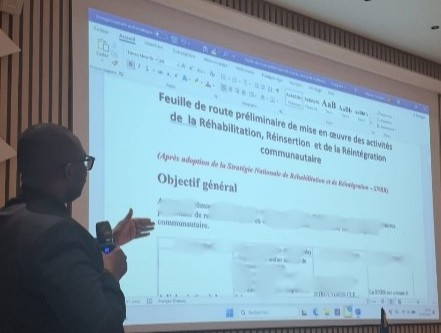
The workshops brought together representatives of relevant public institutions and stakeholders from the justice, security, health, social affairs, employment sectors, as well as administrative and traditional authorities, civil society organizations and experts with experience in disarmament, demobilization and reintegration (DDR), criminal justice and the prevention of violent extremism.
A key objective of the workshops was to examine national provisions and existing mechanisms relating to the rehabilitation and reintegration of persons formerly associated with terrorist groups. Participants also discussed national and international approaches to strengthen a common understanding of the principles and practical considerations relevant to rehabilitation and reintegration processes. Particular attention was given to the relationship between criminal justice processes and rehabilitation and reintegration mechanisms. Discussions addressed screening, the assessment of individual circumstances, the interaction between judicial processes and reintegration measures, and the legal and institutional considerations relevant to decisions concerning prosecution.
The workshops also examined the respective roles and responsibilities of judicial, security, institutional, social and community actors involved in rehabilitation and reintegration. Discussions highlighted the importance of clearly defined mandates, coordination and appropriate information-sharing mechanisms. Respect for applicable legal safeguards and the rights of individuals concerned was also highlighted as a crucial foundation.
Participants further considered the importance of addressing the psychosocial, cultural and socio-economic dimensions of rehabilitation and reintegration. They discussed approaches to mental health and psychosocial support, as well as measures related to vocational training, skills development and employment. These elements are considered as components of a broader and coordinated approach aimed at supporting sustainable reintegration. The role of communities in reintegration processes was also examined, including measures aimed at preventing recidivism, including the need for appropriate coordination among relevant institutional and community actors.
The participants developed a set of priority recommendations to support the operationalization of Niger’s National Rehabilitation and Reintegration Strategy (SNRR), which is scheduled to be officially adopted by the end of the year. These recommendations addressed, among other areas, institutional coordination, access to appropriate psychosocial and social services, socio-economic reinsertion, community engagement, as well as mechanisms for follow-up and prevention of recidivism.
Building on these recommendations, participants also contributed to the development of a roadmap aimed at supporting the implementation of the recommendations and strengthening the coordination and sustainability of rehabilitation and reintegration efforts. The roadmap provides operational orientations for translating strategic priorities into concrete measures and for clarifying the roles of relevant stakeholders in the implementation process.
The activities were implemented as part of the Africa-led CONNECT Strategic Framework and were funded by the Kingdom of the Netherlands.