UNODC and alternative development
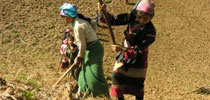
Alternative development means giving farmers an economically viable, legal alternative to growing coca or opium. This lies at the heart of much of UNODC's operational activity at the national, regional and sub-regional levels. UNODC runs projects to this end in Latin America, Southwest Asia and Southeast Asia. The Office helps countries to link their drug control and development policies and strategies to the implementation of projects. In order to ensure that projects are based on local knowledge, skills, interests and needs, UNODC supports governments to apply community-based approaches in the project planning stages and when managing natural resources.
The illicit cultivation of opium poppy and coca bush has been contained in the last decade but much remains to be done. In 1998, UNODC estimated that global illicit opium poppy cultivation totalled 238,000 hectares, with 55 per cent of illicit cultivation taking place in Myanmar and 27 per cent in Afghanistan. A significant progress has been achieved in reducing illicit opium cultivation in Southeast Asia in the last decade. This, however, has been offset by increased cultivation in Afghanistan. In 2007, 193,000 hectares of opium poppies were cultivated in Afghanistan, which now accounts for 93 per cent of global production. Most of the world's coca bush is grown in the Andean countries of Bolivia, Colombia and Peru. Compared with the 191,000 hectares cultivated in 1998, a 18 per cent decline had been achieved by 2006, when 157,000 hectares were cultivated. In 2006, Colombia accounted for 62 per cent of global coca leaf production, Peru, 28 per cent and Bolivia, 10 per cent.
An estimated five million people depend on income derived from the cultivation of illicit drug crops such as coca bush and opium poppy. In most cases these people live below the poverty level and receive on average 50 per cent of their income from drug crop cultivation. Although the drug trade often helps them cope with food shortages and the vagaries of other agricultural markets, economic dependence on illicit crops is not sustainable in the long-term. Forming an enclave in the national economy and excluded from mainstream development, the illicit cultivation of coca bush and opium poppy leaves farmers in the hands of unreliable middlemen. In some countries such as Colombia, many farmers have become mere employees of large commercial farms owned by traffickers of narcotic drugs. Moreover, farmers are continuously confronted with the threat of forced eradication of their illicit crop by the government, which exacerbates their precarious socio-economic condition. Given suitable alternatives, most families would gladly switch to other sources of income.
Challenges ahead
The success of quality alternative development interventions is undeniable; however, many challenges still lie ahead. The gains made in reducing illicit cultivation in key countries over the past decade could come undone if poverty does not abate. Poverty alleviation and sustainable development should continue to be the main goals of alternative development. Food security and income generation programmes should be strengthened to support farmers courageous enough to switch to licit crops. UNODC, together with the affected countries and the international community need to continue their combined efforts to design appropriate and sound policies and programmes to ensure sustainable alternative livelihoods for small farmers and their communities.